Santiago, Chile
Accessible Chile: Santiago, Valparaíso and Vineyards
Description
An accessible 6-day journey through central Chile. Explore Santiago, the capital between the Andes and the valley, from its historic center to its lookouts: the Sky Costanera, the highest in South America, and the summit of San Cristóbal Hill, reached by cable car, with a visit to the National Zoo. Travel to the Pacific coast to discover Valparaíso, a colorful port and World Heritage Site, and Viña del Mar, the Garden City. Raise a glass of good Chilean wine at a vineyard in the Maipo Valley. Private adapted vans, a hotel with an accessible room and guides who accompany you every step of the way. And if you want more, add Isla Negra, Pablo Neruda's house by the sea, or the Rapa Nui extension to see the moai.
Available add-ons
You can add them when booking with Book Now.
Itinerary
Day 1Welcome to Santiago de Chile
Welcome to Chile. On arrival at the airport, our team will meet you and take you to your hotel in an adapted van. The rest of the day is free to rest.
Day 2Santiago city tour
A tour of historic Santiago: the Plaza de Armas, the Metropolitan Cathedral, the La Moneda Palace and the Chilean Museum of Pre-Columbian Art, with its large collection of ancient American cultures. In the afternoon, take the elevator up to the Sky Costanera, the highest lookout in South America, to see the city with the Andes in the background.
Day 3Valparaíso and Viña del Mar
Trip to the coast, about two hours from Santiago. In Valparaíso, a World Heritage Site, we ride the van up to the hilltop lookouts to see the port, the colorful houses and the murals. Then Viña del Mar: the Flower Clock, the seafront avenue facing the Pacific, and the moai at the Fonck Museum, brought from Rapa Nui. Return to Santiago. ♿ The hills are very steep, so we drive up to the lookouts by van.
Day 4Maipo Valley vineyards
Visit to a traditional winery in the Maipo Valley, less than an hour from Santiago. A tour of the vineyards and the cellar along routes without steps, with a tasting of Chilean wines. Free afternoon. OPTIONAL: full day to Isla Negra, Pablo Neruda's house ($270 per person).
Day 5San Cristóbal Hill and the National Zoo
Ride the cable car, with accessible cabins, to the summit of San Cristóbal Hill: the Sanctuary of the Immaculate Conception and the best view of Santiago with the Andes behind. Descend on the Pío Nono line to the Zoo station to visit the National Zoo. Free afternoon to explore the Lastarria neighborhood.
Day 6Time to say goodbye...
At the scheduled time, transfer by adapted van to the airport. After 6 days among the Andes, the Pacific and the vineyards, you will take Chile in your heart. Thank you for traveling with us, and see you at the next accessible destination! If you take the extension, today you fly to Rapa Nui.
Includes
- Accessible hotel (adapted room, 5 nights with breakfast)
- Airport–hotel–airport transfers (adapted van)
- Bilingual tour guides (Spanish - English)
- Santiago, Valparaíso and Viña del Mar city tour, Maipo vineyard, and San Cristóbal Hill with the National Zoo
- Entrance to the Pre-Columbian Museum, Sky Costanera, cable car and zoo
- Wine tasting
- 24/7 assistance at destination
Not included
- International flights from your country to Chile
- Santiago – Rapa Nui flight
- Travel insurance
- Tips, meals not mentioned in the description, alcoholic and non-alcoholic drinks, other services
Frequently asked questions
1. Personal experience and assistance
Will my companion have to push or carry my wheelchair during the tours?
No, they will not have to do it alone. On every transfer and excursion a guide accompanies you and, where the route requires it, support staff from our local operator. We choose routes with flat paths, ramps or elevators so your companion can enjoy the trip as a traveler and not as a caregiver. In Rapa Nui, rough terrain is covered with an all-terrain chair and two assistants.
Will the pace be exhausting for me or too slow for my companion?
We balance every day: one main activity per day, free time, and schedules that respect your rest, hygiene and transfer times, without giving up the key sights. It is a program with a single base in Santiago, without changing hotels, and with free afternoons.
Does the staff speak English and are they trained in mobility assistance?
Yes. All programs include bilingual guides (English and Spanish). We work with local operators experienced with travelers with reduced mobility, and Accessible Travel Peru, with more than 12 years of experience in accessible tourism, coordinates and supervises every detail of your trip.
2. Transport, flights and your own equipment
Can I bring my own wheelchair (electric or manual) and what happens on domestic flights?
Yes, you can travel with your own equipment. When you book, we will ask for the measurements, weight and technical specifications (such as the battery type for powered chairs) to coordinate with the airlines and secure safe transport in the hold. We also arrange airport assistance on arrival and at your connections. The base program has no domestic flights; the Rapa Nui extension includes the Santiago – Rapa Nui flight (5 to 6 hours, not included). The island's airport has no jet bridge: staff carry you down the stairs in a transfer chair.
How do we get between cities and attractions?
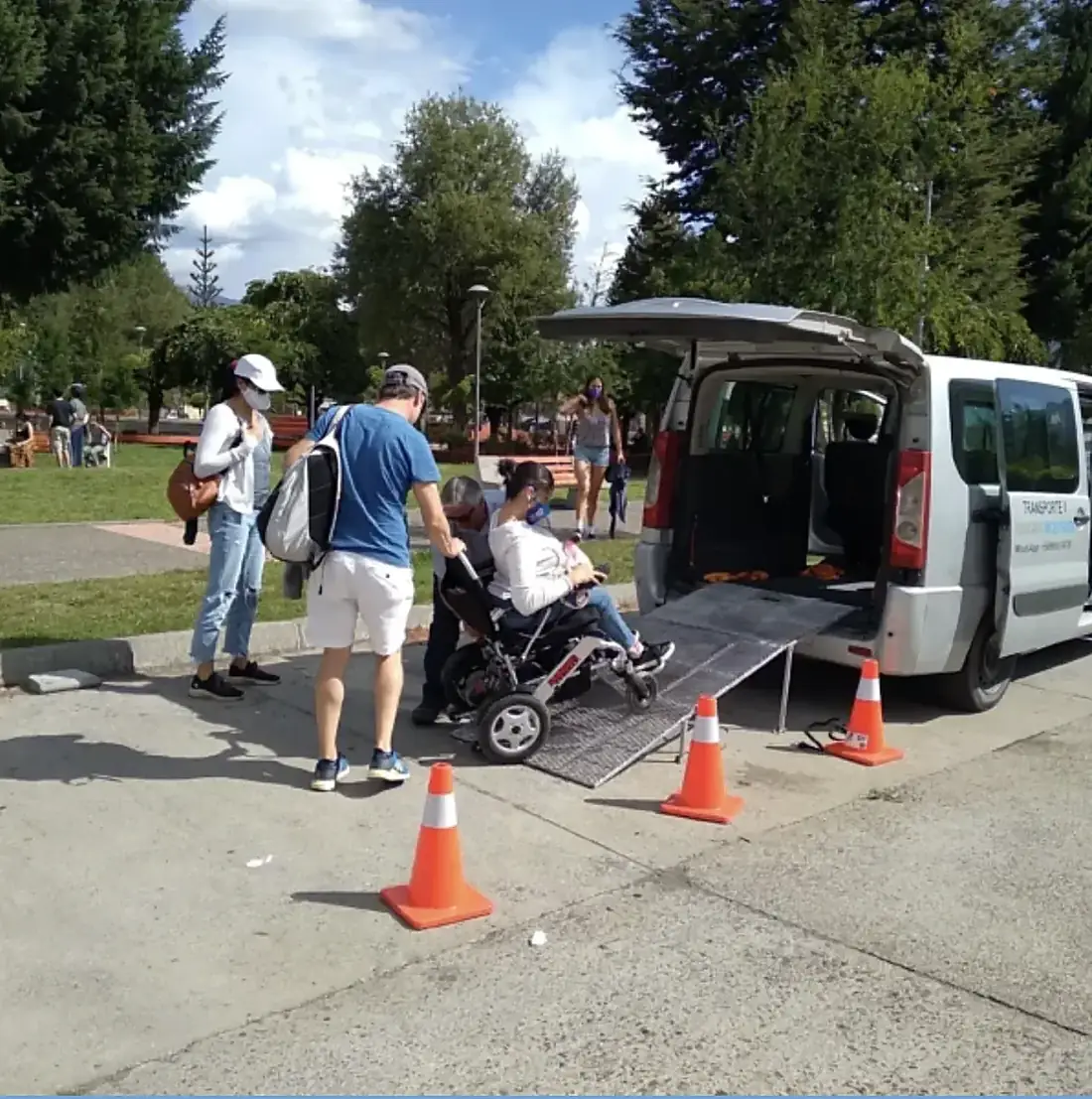
Always in private adapted vans with a ramp or elevator. Rapa Nui has no vehicles with an elevator, so we recommend a manual chair.
Is it easy to get an accessible taxi on the street on my own?
Not with regular service. In Chile, street taxis and standard ride-hailing apps rarely have a ramp or space for wheelchairs without folding them. That is why all transfers in the program are private and adapted. If you want to go out for dinner or a walk during your free afternoons, we can arrange adapted transport for you.
What if my wheelchair breaks down during the trip?
We coordinate with our local operator for an immediate solution: a replacement chair and contact with the city's technical services, so your itinerary does not stop.
3. Accessibility at monuments, hotels and bathrooms
Are Valparaíso and Neruda's houses accessible?
Valparaíso's hills are very steep and its historic funiculars are not adapted, so we drive you up to the lookouts by van. Viña del Mar is flat. Of Neruda's houses, Isla Negra is the most accessible (the exterior and the tomb facing the sea are easy to visit; part of the interior has narrow corridors). La Chascona and La Sebastiana have many stairs.
Can I see the moai up close on Rapa Nui?
Yes. Ahu Tahai and Ahu Tongariki are easy to visit. At Rano Raraku the ground is sloped and rocky, so we use an all-terrain chair with two assistants. The beaches are not accessible all the way to the water.
Will I have access to adapted bathrooms during long journeys and tours?
Yes. It is one of our priorities. On full-day excursions we plan stops at places with accessible restrooms (wide doors, grab bars and step-free access).
What kind of hotel rooms do you select?
We do not book standard rooms; we book adapted ones: step-free or elevator entrance, wide doors, beds at a height suitable for transfers, and a bathroom with a roll-in shower and safety bars.
4. Health, climate and documents
What is the climate in Chile and what should we pack?
Santiago: dry, hot summer (December to March, up to 30 °C or more); cold winter (June to August, 0 to 15 °C). Valparaíso and Viña: cooler than Santiago, with sea breeze. Bring a jacket. Rapa Nui: subtropical, between 18 and 28 °C, with short rains at any time of year.
Do I need a visa or other documents?
Most nationalities from the Americas and Europe do not need a visa for tourism in Chile. For Rapa Nui, the Single Entry Form is completed before the flight, and the national park entrance (US$ 100) is included in the extension. We can help you check according to your passport.
5. Money, electricity and connectivity
What currency is used in Chile and is it easy to pay by credit card?
The official currency is the Chilean peso (CLP); in November 2026 one US dollar is worth about 1,000 pesos. Cards are accepted almost everywhere.
What plug type and voltage are used in Chile?
The voltage is 220V with type C and L plugs. Bring an adapter. Most modern chargers for phones, laptops and wheelchairs are dual voltage (110V–240V); check the label on your charger.
Is there good internet and Wi-Fi coverage?
Yes. There is Wi-Fi in hotels and good 4G signal in Santiago and on the coast. In Rapa Nui the connection is slower.
Can you provide a local SIM card or eSIM when I arrive?
Yes. We can help you activate a data eSIM before the trip, or arrange a local SIM card for your arrival.

Shall we talk about your trip?
Write to us or book with WeTravel
Tell us your dates and accessibility needs and we will reply with a proposal.
Reviews
Travelers recommend us
Read what travelers who already went with us say, on WeTravel and TripAdvisor.